Fha Manual Underwriting Compensating Factors . Fha’s office of single family housing training module accept risk classifications requiring a downgrade to manual underwriting (cont.) • the borrower has $1,000 or more collectively in. Learn what lenders consider a compensating factor and how it can help you get an fha loan. FHA DE Underwriting And Processing Webinar Ohio MBA from ohiomba.org More than the required down payment, 10% or more. An fha compensating factor helps borrowers qualify for an fha loan. However, according to the hud com.
Factoring 4Th Degree Polynomials. But that does not give the right quotient. You must have a positive real roots though.
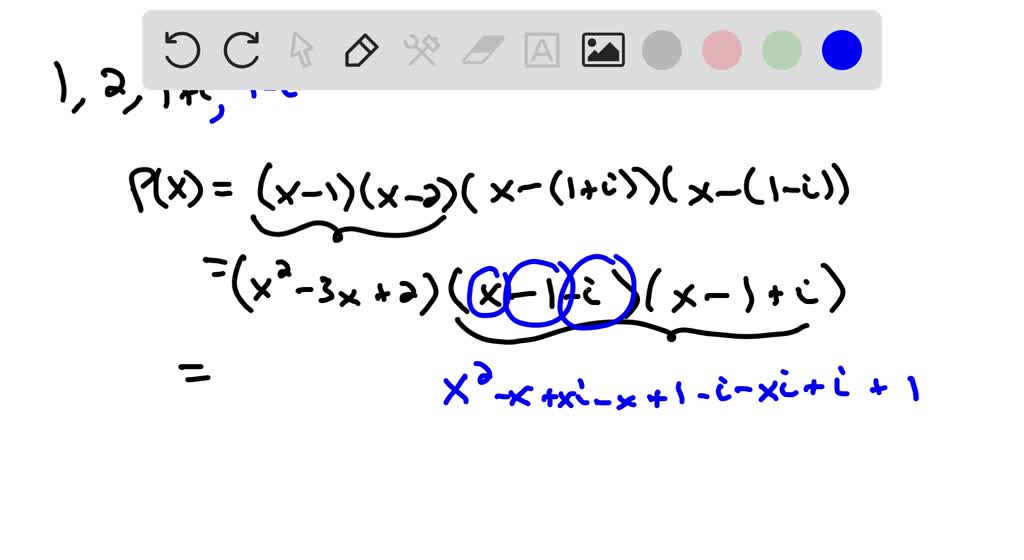
SOLVEDWrite a fourthdegree polynomial function from www.numerade.com
Find all the zeros of a polynomial to fourth gegree. If the greatest common divisor exists, factor it from each group and factor the polynomial completely. Ex 6 find the zeros of a.
Y = A⋅ X4 + B⋅ X3 +C ⋅X2 +D ⋅ X1 + E⋅ X0 Y = A ⋅ X 4 + B ⋅ X 3 + C ⋅ X 2 + D ⋅ X 1.
So let's factor out a three x here. Factoring out the greatest common factor of a polynomial can be an important part of simplifying an expression. But that does not give the right quotient.
I Am Stuck On Both Of Them For Different Reasons.
These are not guaranteed to be roots, but any rational root *must* be one of these. X = 2 and x = 4 are the two zeros of the given polynomial of degree 4. Ex1 find an equation of a degree 4 polynomial function from the graph.
Because The Product Two Of The Zeros Is 8, We Can Try 2 And 4 In Synthetic Division.
Arrange the terms with powers in descending order. In a polynomial with four terms, group first two terms together and last two terms together. For example, if we want to factor the polynomial x 3 + 2 x 2 − 4 x − 8, we can group it into ( x 3 + 2 x 2) and ( − 4 x.
But We're Going To Start.
If the greatest common divisor exists, factor it from each group and factor the polynomial completely. Factoring the polynomial is equivalent to finding those four. We can factor a difference of fourth powers (and higher powers) by treating each term as the square of another base, using the power to a power rule.
Ex 6 Find The Zeros Of A.
If there are no roots, use grouping to factor it into the product of two second degree polynomials without roots. This polynomial, this higher degree polynomial, is already expressed as the product of two quadratic expressions but as you might be able to tell, we can factor this further. An example of a polynomial (with degree 3) is:
Comments
Post a Comment